Two kinds of notice sit in the same column
Exchanges file delistings into one feed. Binance keeps its version here, and in the October 2026 screenshot below the top of that column read, in order: a futures notice removing several USDⓈ-M perpetual contracts, a notice of removal of spot trading pairs, a margin and loans token delist, a notice closing a Ukrainian hryvnia fiat channel together with the USDT/UAH pair, and a notice of removal of margin trading pairs. Five entries, five different scopes — and every one of them reads as “delisted” if you catch only the first few words.
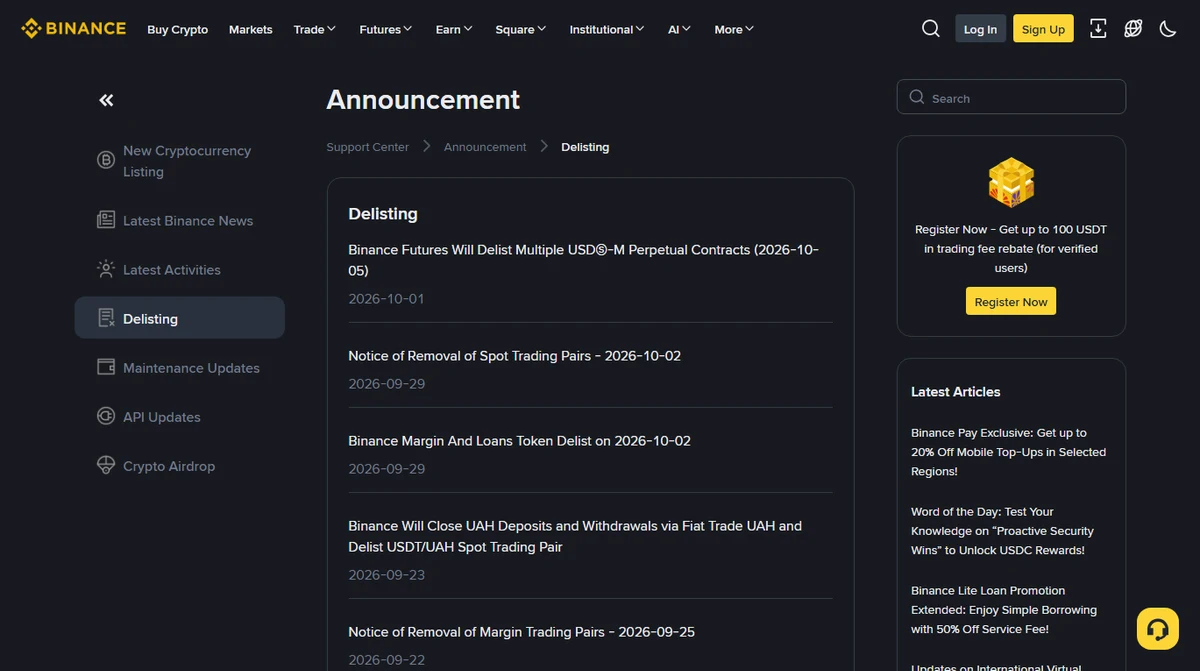
Removing a trading pair removes one way to trade the token. The spot-pair notice effective 2026-10-02 covered AUCTION/USDC and VANA/USDC. It says the underlying tokens remain available through other pairs on Binance Spot. Poor liquidity and trading volume are listed as possible reasons for removing pairs; the notice does not disclose either pair's trading data or identify which factor determined these removals.
Delisting a token closes the entire market for it on that venue. The USDP notice filed in that same category is of this second kind, and it comes with a timetable: trading stops, orders are cancelled, deposits stop crediting, withdrawals get a deadline.
A shortened headline can hide whether the notice concerns a pair or a token. Read its scope before using it to explain a price move. A reversal after the headline does not, by itself, show that traders corrected a misunderstanding; that would require evidence about the timing, orders and other news.
A genuine delisting notice is a timetable
The USDP notice, published on 2026-09-10, sets four separate moments. The English original uses UTC; the times below are converted to UTC+8 by adding eight hours.
- 24 September 2026, 11:00 — trading stops and the token is delisted. The notice states that open orders are cancelled automatically at that point. A limit order parked in the book will not sit there holding your exit for you.
- 25 September 2026, 11:00 — deposits stop crediting. Send more of the coin to that exchange afterwards and it will not appear in your balance.
- 24 November 2026, 11:00 — withdrawals close. Two full months after trading stopped.
- From 25 November 2026, 11:00 — the platform may convert leftover delisted tokens into stablecoins on holders’ behalf. The notice does not guarantee that conversion will take place. It also says withdrawals will remain open, subject to network availability, if conversion is not feasible.
Laid out like that, two features of the schedule stand out.
The first: a long gap separates the trading halt from the withdrawal deadline. Anyone still holding the coin has a route other than selling into this venue’s closing hours — moving it somewhere that still trades it is the behaviour the notice itself is built around. That gap is the main hole in the popular inference that a delisting forces every holder to dump in the same place at the same time.
The second: the conversion clause is written with “may” and “cannot be guaranteed”. Conversion itself is uncertain, and the notice does not commit to an exchange rate or valuation time. Neither conversion nor a particular exit price should be assumed.
Each deadline matters to a different action: trading, deposits and withdrawals stop on separate schedules. Anyone relying on this venue to sell needs the trading deadline; anyone planning to transfer needs the withdrawal deadline and confirmation that the receiving platform supports the token and network. The later withdrawal date does not keep trading services open.
The days before trading stops, read through the order book
In these two examples, the announcement and effective dates were two weeks apart for USDP and three calendar days apart for the spot pairs. Those dates alone do not explain a price move. To assess a liquidity explanation, compare bids, asks and spreads before and after the notice; the following describes possible responses, not order-book observations from these events.
Some holders may prefer selling on the exchange to transferring their coins. As the trading deadline approaches, they may accept a lower price to complete a sale. Others may keep a limit price, withdraw or continue holding; a deadline does not make every seller indifferent to price.
Market makers may also reduce bids or widen spreads if they expect inventory to become harder to sell or hedge. Transferring coins elsewhere can add cost and risk, but the response depends on the other markets available. If buy-side depth falls, the same market sell can consume more price levels. Whether that happened before a particular delisting requires order-book data. The order book depth and impact cost tool illustrates this relationship for a specified book and order size.
If the coin also has derivatives on it, the spot book is only part of the story. Perpetuals being delisted, or the asset being struck off the list of accepted collateral, both change how much adverse movement leveraged positions can absorb, which opens the door to the forced-liquidation path. Notice the first and third entries in the screenshot above: futures delistings and margin collateral delistings are filed as their own announcements, on their own dates, and they frequently fall out of step with the spot one.
One venue dropping a coin leaves the rest of the market standing
Price forms across every venue at once. When one exchange removes a coin, the liquidity that disappears is its share, not the whole.
The size of that share is the question worth asking. Where the venue carried most of the coin’s turnover, what remains afterwards is thin and scattered: spreads widen, fills get worse, and the damage is real whether or not the coin trades elsewhere. Where the venue handled a minor slice, the symbolism of the notice outweighs the liquidity lost — though symbolism gets priced too, because other platforms may follow.
Hence the same word producing two completely different charts: one coin barely registers the notice, another loses a layer of its book on the spot. The wording of the announcement explains none of that. How much of the coin’s volume lived at that venue explains most of it. The same arithmetic is why smaller tokens fall harder — they lean on a handful of venues to begin with, so losing one is a different order of event for them.
Monitoring Tags can signal delisting risk
Binance flags a set of tokens with a Monitoring Tag. The official explanation describes them as carrying higher volatility and risk than other listed tokens, and requires users to pass a quiz on the spot and/or margin platform every 90 days, and accept the associated terms, to keep trading them. The platform reviews the list periodically and can add or remove the tag.
The effect on price is structural, and slow.
The quiz adds a step before a new user can trade a tagged token. That may discourage some buyers, while the warning may lead others to price in delisting risk. The tag does not set a countdown: it can be removed after review, and does not establish that delisting will happen.
If traders have already anticipated a delisting, an announcement may add less new information than its headline suggests. This is one possible explanation for a muted reaction, not a conclusion that can be drawn from the notice alone; see why the price already moved before you saw the news.
On this site’s reading, a delisting belongs to structural events: a rule changed, which puts it on a different footing from ordinary swings in supply and demand. The route it travels to reach the price, though, runs through liquidity — a thinner book, a narrower exit. The event is the starting point; supply and demand is the road.
Two conclusions the notice will not support
That the coin is going to zero. A delisting records one exchange’s commercial and compliance decision, and the stated grounds tend to be liquidity, volume and how responsive the project team has been. The token continues to exist on its chain, and other venues may continue to quote it. What the platform decided and what becomes of the project are separate questions; the first settles nothing about the second.
That the selling is finished and the coin is cheap now. Inferences in that direction fall outside what this site does, and nothing above would support one.
The mechanism supports a narrower statement: the market left behind after a delisting is thinner, so moves in both directions get sharper and the friction cost of trading rises. Degraded liquidity cuts both ways, and it has nothing to say about value.
Next time the word “delisted” turns up, read in this order
- Find the notice itself, not a summary of it. Every major exchange files delistings under their own category — the screenshot above is one such page. Truncated headlines and mangled translations enter at the retelling stage, almost without exception.
- Sort it first: pair removal, or token delisting? For pair removal, check affected orders and trading bots: the spot-pair notice says bot services will end. For token delisting, also check deposits, withdrawals and other affected products.
- Copy out the dates. Trading halt, deposit cut-off, withdrawal deadline, automatic conversion. Convert them out of the exchange’s timezone while you are at it.
- Work out how much of the coin’s volume lived on this venue. That ratio decides whether the liquidity loss is substantial or mostly symbolic.
- Check for companion notices on futures and margin. They carry their own effective dates and hit a different layer.
Five steps, and at the end of them you still won’t know where the price goes next; this site has nothing to offer on that. What you will know is what the notice changed, and whether the part it changed can account for what the chart is doing.