Three definitions first
- Margin — the capital you post to hold a notional position much larger than itself. Ten-times leverage means one unit of margin supporting ten units of notional.
- Maintenance margin ratio — the minimum ratio the exchange requires. Breach it and the position enters forced closure. Not a warning; an execution.
- Forced liquidation — a closing instruction issued by the system rather than by you. Its only objective is to close the position quickly and contain risk, which makes it insensitive to the execution price.
That last point is the hinge of the whole article. A normal trader waits when prices are bad. A liquidation engine does not. The market therefore contains a class of orders that must fill regardless of price, and those orders are the fuel for instantaneous moves.
The four stages of a cascade
-
The initial push, usually small
A macro release, one large market order, or simply ordinary volatility in a thin hour. One or two percent is enough, and by itself it wouldn't be worth reporting.
-
The first tier goes: highest leverage first
Higher leverage means less room for error, and you can work the step out yourself: a position's initial margin ratio is roughly one divided by the leverage multiple, and liquidation does not wait until the margin is gone — it fires the moment the margin ratio falls below the maintenance margin ratio. So the trigger distance is about one divided by the multiple, minus the maintenance margin ratio, which makes it somewhat smaller than one over the multiple. At fifty times, one over the multiple is two percent, so the real trigger is under two percent; at ten times it is ten percent, and the real trigger is under ten percent as well. Each platform sets the maintenance margin ratio per position tier, so take the number from the public documentation of the platform you use. Whatever it is, the conclusion holds: the most aggressive positioning always goes first.
-
Price steps down, reaching the next tier
Forced sales consume the bid levels beneath, the traded price moves lower, and positions at the next leverage tier enter their liquidation range. The loop is running, and each round supplies fuel for the next.
-
Liquidity leaves, impact multiplies
In violent conditions market makers widen their quotes or temporarily pull orders to control risk. The book thins, so the same size produces a larger price move — the most frequently overlooked stage, and the direct cause of the “wick” shape. When the fuel is exhausted and market makers return, price usually recovers part of the move.
Reading the leverage level from public data
A cascade needs fuel, and the fuel is leveraged positions already established. Three public indicators measure the level:
1. Open interest
The total notional value of open contracts. Rising means leverage is accumulating; a sharp fall after a violent move means that batch of positions was cleaned out. The before-and-after gap is the most direct evidence available for “was this a liquidation-driven move”.
2. Funding rate
Perpetual contracts have no expiry, so they need a mechanism to hold their price near spot: longs and shorts pay each other periodically. When the contract trades above spot the rate is usually positive and longs pay shorts; below spot, the reverse.
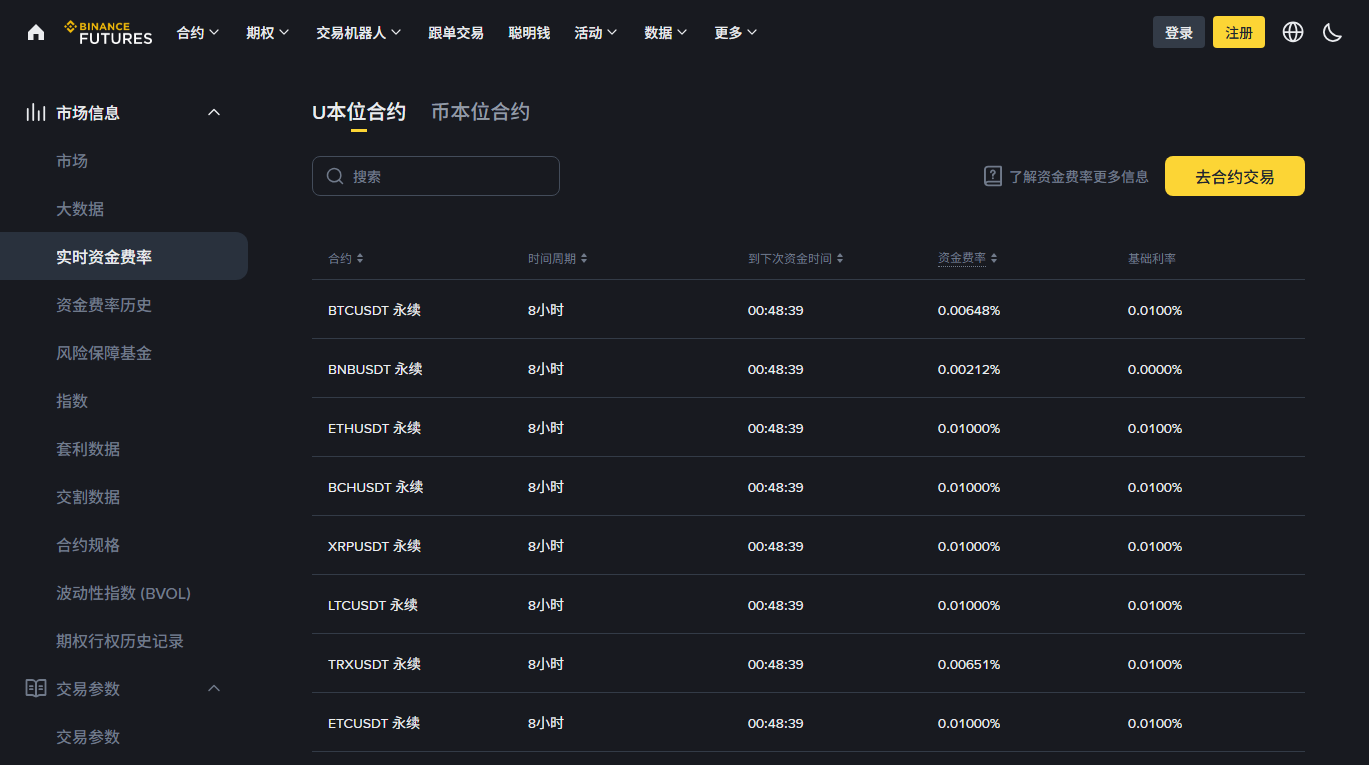
The crucial part is how to read it: funding measures how crowded positioning is, not whether it's correct. Persistently positive means longs are numerous enough to keep paying to hold. That says longs are crowded. It does not say longs will be right or wrong. A crowded side simply supplies more liquidation fuel if the market turns. Current readings across major contracts are in funding rates and leverage.
3. Liquidation data
The notional value and number of accounts force-closed over a window, plus the long/short split. Long liquidations exceeding shorts corresponds to an amplified decline; the reverse is a squeeze. These aggregates are compiled from various platforms' endpoints, so read magnitude and direction, not precision.
Why it happens at the worst moments
Cascades cluster in identifiable conditions, none of them mysterious:
- The thinnest hours — outside major markets' sessions, holidays, deep night. The same order has more impact.
- Just after leverage peaks — maximum fuel.
- After a long stretch of low volatility — calm encourages people to raise leverage, which places liquidation levels closer to the current price. Low volatility accumulates the fuel for the next burst of high volatility, a stable reflexive feature of this market's structure.
This article explains amplification at the market level. It says nothing about how much leverage you should use, where to place anything, or whether to close. That's personal risk management, dependent on circumstances we neither know nor assess. The one neutral fact: higher leverage means less room for error. That's arithmetic, not opinion.
Common questions
Is the exchange hunting my position?
Liquidation is triggered by maintenance margin rules that are public and applied identically to every account. But prices genuinely can dislocate briefly during violent moves — when the book thins, execution prices can depart substantially from the norm. That's a consequence of liquidity structure, not targeting. Specific liquidation-price formulas and margin rules are in each platform's public documentation.
Why does price often bounce right after a cascade?
Because forced selling is involuntary and price-insensitive, so it pushes price away from where ordinary supply and demand would clear. Once the fuel is spent and market makers resume quoting, some of the move is retraced. That describes a shape that has occurred; it is not an expectation about the next one.
I don't use leverage — why does this affect me?
Because spot and derivatives share one price discovery process; forced closures in the derivatives market transmit into spot through arbitrage and matching. Not using leverage doesn't exempt you from the consequences of other people's leverage.
Does positive funding mean I should short?
We give no directional judgement. Mechanically, it reflects how crowded positioning is; historically, crowded sides have both been washed out and continued for extended periods. Using a single indicator as a signal has no foundation.