Which rule it changes
Every time the bitcoin network produces a block, the miner who assembled it receives a block reward — the only way new bitcoin enters circulation. The protocol specifies that every 210,000 blocks, that reward is cut in half.
The initial reward was 50 BTC, so the sequence runs 50 → 25 → 12.5 → 6.25 → 3.125, continuing until it can no longer be subdivided. Combined with the rule that the reward only ever halves and never increases, the total supply is capped at 21 million, and at the current rate the last fraction won't be mined until the twenty-second century.
The halving changes exactly one thing: the rate at which new supply arrives. It doesn't change how much bitcoin already exists, it doesn't touch anyone's holdings, it doesn't alter trading rules, and it doesn't modify any mechanism connected to price. It is a change in the slope of the supply curve — which places it where layer 1 (supply structure) meets layer 4 (structural events) in the four-layer framework.
The halving schedule is public and computable years in advance. It is not breaking news, and there is no informational advantage in knowing about it. That fact gets used repeatedly later in this article: an event that everyone has known about for four years affects prices through a completely different mechanism than a piece of breaking news does.
Why “roughly every four years”
The protocol specifies a block count (210,000), not a period of time. The reason it works out to about four years is a second rule that stabilises the block rate: difficulty adjustment.
Every 2,016 blocks — about two weeks — the network recalculates mining difficulty with the goal of holding the average block interval near ten minutes. If hash power floods in and blocks come faster, difficulty rises; if hash power leaves and blocks slow, difficulty falls. So 210,000 blocks works out to roughly 210,000 × 10 minutes, or about 3.99 years.
Which means the exact date of a halving cannot be fixed in advance — it only converges as the block height approaches. You can watch this machinery running on any public block explorer.
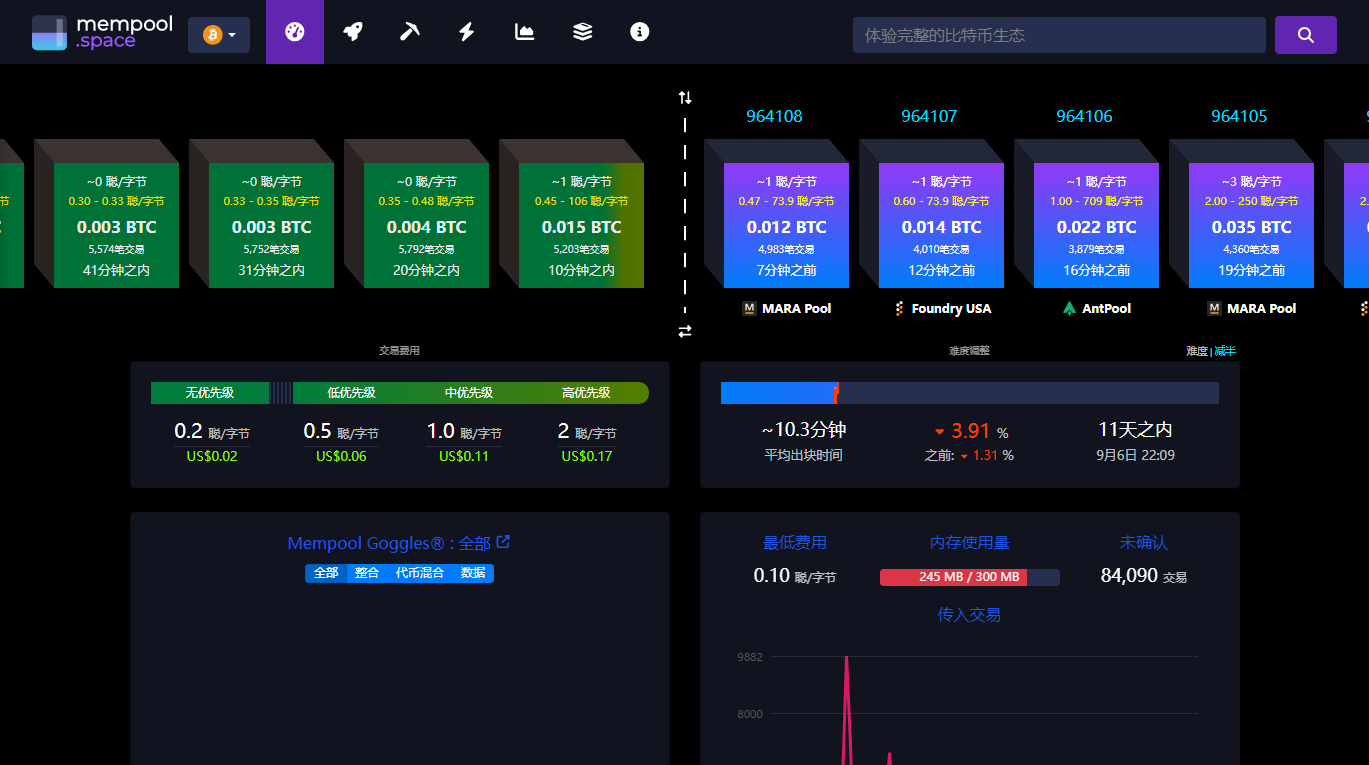
Extrapolating from the height in that screenshot: the next halving occurs at height 1,050,000, roughly 86,000 blocks later, which at ten minutes a block is about a year and a half away. That estimate drifts with actual hash power. It is a range, not a date.
Four halvings, facts only
The table below contains only protocol-level facts — every figure can be independently confirmed on any block explorer. It contains no prices, because this article is about what happened, and price requires a separate discussion about causation.
| # | Block height | Date | Reward change | Daily new supply |
|---|---|---|---|---|
| First | 210,000 | 2012-11-28 | 50 → 25 BTC | ~7,200 → 3,600 BTC |
| Second | 420,000 | 2016-07-09 | 25 → 12.5 BTC | ~3,600 → 1,800 BTC |
| Third | 630,000 | 2020-05-11 | 12.5 → 6.25 BTC | ~1,800 → 900 BTC |
| Fourth | 840,000 | 2024-04-20 | 6.25 → 3.125 BTC | ~900 → 450 BTC |
| Next | 1,050,000 | ~2028, hash-rate dependent | 3.125 → 1.5625 BTC | ~450 → 225 BTC |
2012: almost nobody noticed
Bitcoin was tiny, participation was largely technical, there was no meaningful derivatives market and no mainstream coverage. The confirmable fact is that the reward went from 50 to 25 and the network kept producing blocks. As a data point for later arguments it's of limited use — that market has almost nothing in common with today's.
2016: the first one that was widely anticipated
This time there was extensive advance discussion and countdown pages. Factually: the reward went from 25 to 12.5 and the transition was uneventful; mining had already shifted from consumer hardware to purpose-built machines and pools, with a marked increase in concentration.
2020: landed in a year of macro upheaval
The reward fell from 12.5 to 6.25. What makes this one distinctive is that it occurred during a year of enormous change in the global macro environment — large-scale easing by multiple central banks altered conditions for every risk asset simultaneously. This is the hardest situation for causal analysis: several variables capable of moving prices independently all changed in the same period, so none of them can be isolated.
2024: miner revenue structure briefly rewritten
On 20 April 2024, at height 840,000, the reward fell from 6.25 to 3.125. This one left behind a fact worth remembering: the halving block itself carried unusually high fee revenue — a new protocol launching on-chain had congested the network, and public records show total fees in that block reaching several dozen BTC, far above the 3.125 BTC block reward.
That matters not as a curiosity but as a preview of a long-run question: when the block reward keeps halving toward zero, what keeps miners in business? The protocol's answer is transaction fees. And as the screenshot above shows, on an uncongested ordinary day fees are a very small fraction of the block reward. How that gap eventually closes has no settled answer.
What actually happens on the network that day
Many people assume a halving is an upgrade — that somebody executes it and users have to cooperate. Neither is true.
The rule has been in the code every node runs since day one. When a miner produces block 839,999, every node on the network is counting by the same rule; the moment block 840,000 is broadcast, each node independently checks that its reward is exactly 3.125 BTC — and if a miner tried to award themselves more, the entire network would judge that block invalid and discard it. No vote, no announcement, no transition period, no pause between the two blocks.
As an ordinary user you do nothing at that moment: no wallet upgrade, no transfer, no “confirming your holdings”. Worth committing to memory, because every halving brings a wave of phishing messages framed as a required “halving upgrade”.
How to verify all of this yourself
Every protocol fact in this article is independently checkable, and the method is simple: open any public block explorer and search a block height (say 840000). The page shows the timestamp, transaction count, total fees and block reward. Put blocks 839,999 and 840,000 side by side and you can watch the reward drop from 6.25 to 3.125 with your own eyes. You don't have to trust this site, and you don't have to trust any media outlet.
How the arithmetic works on the mining side
To understand the direct consequences you need to know what miner revenue consists of: revenue = block reward + fees in that block, against costs that are mostly electricity, hardware depreciation and operations.
Miners compete in proportion to hash power: if you run one thousandth of the network, over time you collect about one thousandth of the blocks. So a single machine's daily revenue depends on three variables — its efficiency (power consumed per unit of hash), the price of electricity, and network difficulty. A halving cuts the block-reward part of the revenue term in half (the fee part is unaffected) and leaves the cost term untouched.
Hence an industry term: the shutdown price, the point at which mining revenue falls below the electricity bill and running the machine is a pure loss. Shutdown prices vary enormously between hardware models and power contracts, so what leaves after a halving is not “miners” but the miners with the worst cost structures. That's why every halving is accompanied by fleet upgrades and capacity migrating toward cheaper power.
To be explicit: all of the above describes miners' operating conditions, not a price judgement. Miners are one continuous source of selling, but their daily output (currently around 450 BTC) is a small fraction of major venues' daily turnover, and treating miner behaviour as a price driver is usually a scale mismatch — discussed more fully in layer 1 of the four layers.
Three numbers people mix up
- 21 million: the supply cap. The maximum the protocol will ever allow to exist, not fully issued until the twenty-second century. It is not “how much exists now”.
- Circulating supply: what has already been mined. It grows with every block, but very slowly now — the accumulated result of four halvings.
- Actually movable supply: less than circulating supply. A meaningful quantity of bitcoin is permanently unreachable because private keys were lost. That amount can only be estimated, never counted, and anyone claiming a precise figure is not credible. Market cap calculations use circulating supply and do not deduct lost coins, which is one more reason market cap is a crude measure.
Why the “scarcity model” isn't a conclusion
The most popular class of argument around halvings converts the fall in new supply into a scarcity metric and then derives a price from it. The best known is stock-to-flow: existing supply divided by annual new supply, so a higher ratio means greater scarcity, and every halving steps the ratio up.
As a description, there's nothing wrong with it — it accurately characterises the shape of the supply curve. The problem starts when it's used as a price model:
- It has one independent variable. The supply curve was fully determined decades in advance, so such a model is explaining price with a known curve while everything on the demand side — who's buying, why, what the substitutes are, what the macro environment is doing — sits outside it.
- Its input contains no new information. Since the supply curve is common knowledge, any inference drawn from it is common knowledge too, and confers no advantage.
- It has been published, tested and visibly diverged. Trajectories from this class of model have departed significantly from what followed, and the models themselves have gone through repeated revision. A model that needs continual patching to fit the past says nothing credible about the future.
More fundamentally: scarcity is not value. Something being scarce tells you supply is limited. It doesn't tell you anyone wants it. Price is always the collision of supply and demand, and an argument that only addresses one side is incomplete by construction.
The next halving: what's certain and what isn't
Certain: it occurs at block height 1,050,000; the reward falls from 3.125 to 1.5625 BTC; daily new supply falls from about 450 to about 225 BTC. All of it is in the protocol and requires nobody's approval.
Not certain: the exact date (hash-rate dependent, so only a range); how miners respond; the level of fees; and most importantly — price. This site makes no judgement of any kind about that, including implied ones.
To check the four halvings' facts item by item, use the halving facts table, which lists facts and does no extrapolation.
Common questions
Does the halving change how much bitcoin I hold?
No. It changes the reward on new blocks and touches no existing balance. Your holdings are identical before and after and require no action from you. Any message telling you to “upgrade your wallet for the halving” or “transfer to a designated address to claim” is a scam.
Why can nobody give an exact halving date?
Because the trigger is a block height and block times only average ten minutes. Faster hash-power growth produces blocks slightly ahead of schedule and vice versa. The estimate tightens as the height approaches; before that it's a range.
Does the halving make the network less secure?
There is short-term hash-rate volatility, but difficulty adjustment is a negative feedback loop: when hash power drops far enough, difficulty follows and per-unit revenue for remaining miners recovers. The genuine long-run question isn't any single halving — it's whether fees can fund an adequate security budget once the block reward approaches zero, and that is an open problem.
Do other coins have halvings?
Some proof-of-work coins copying bitcoin's issuance curve have similar mechanisms, with different parameters. More importantly, their market structure, liquidity depth and holder composition differ enormously, so arguments about bitcoin can't simply be transplanted.
Should I do something before or after a halving?
This site gives no timing advice, so that question is outside what we answer. What can be said informationally: the schedule is public and known to every participant, so there is no “knowing before others” advantage available.